Table of Contents
On October 15, 2026, Chalkbeat reported that Teachers Pay Teachers (TPT), the marketplace where many U.S. teachers buy and sell lesson materials, is moving to ban AI-generated resources. If you buy worksheets there, or sell them, the Teachers Pay Teachers AI ban raises obvious questions: what exactly is banned, when does it start, and what happens to listings that already exist?
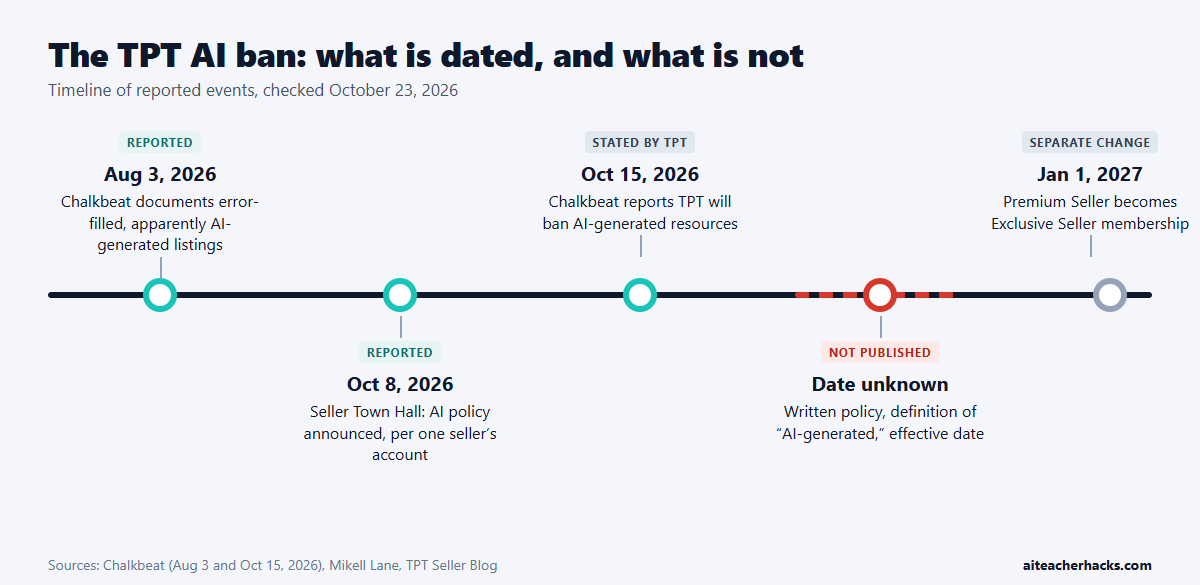
The honest answer is that, as of October 23, 2026, TPT has said what it wants (a marketplace that is “AI-free”) but we could not find the detailed rules, an effective date, or a definition of what counts as AI-generated. This article separates what is confirmed from what is only reported, and covers both sides of the marketplace.
Quick answer
- TPT says seller material should be “unique, expertly crafted, and AI-free,” according to Chalkbeat.
- We found no written policy, effective date, or definition of “AI-generated” on TPT’s help pages.
- One seller’s account of the town hall says covers, thumbnails, previews and descriptions are in scope, and that sellers should start replacing AI content in existing listings.
- Buyers: nothing in the reporting says your past purchases are affected.
What TPT Has Announced, and What It Hasn’t
According to Chalkbeat’s reporting by Lily Altavena, TPT announced the policy at a seller town hall the week before the October 15 story. TPT spokeswoman Sarah Lehman told Chalkbeat that material on the marketplace “should be unique, expertly crafted, and AI-free,” and that the company is building tools to “identify and remove AI-generated resources.”
A more detailed account comes from a post by seller-educator Mikell Lane, who writes that the announcement came at TPT’s October 8 Seller Town Hall. In Lane’s account, a member of TPT’s product team said the company is committing to keeping TPT “teacher created, classroom ready, and AI free.” Lane reports that the policy covers resource files, covers, thumbnails, previews and descriptions, that sellers were told to begin replacing AI-generated content in existing listings, and that TPT promised more guidance “in the coming weeks” with no firm deadline.
We could not check that second-hand account against a TPT document. As of October 23, TPT’s own Seller Guidelines and Content Guidelines help pages contain no AI-specific wording. The Seller Guidelines still say only that sellers should sell resources they have produced or designed themselves, and that listings must be truthful, accurate and free of mistakes. Treat the details above as reported, not official, until TPT publishes them.
Confirmed, Reported, and Still Unknown
| Question | What we know | Status | Source |
|---|---|---|---|
| Is TPT banning AI-generated resources? | A TPT spokeswoman says seller material should be “AI-free” | Stated by TPT, as reported | Chalkbeat, Oct 15, 2026 |
| When does it start? | No effective date has been given | Unknown | Chalkbeat |
| Does it cover covers, thumbnails, previews and descriptions? | One seller’s account of the town hall says yes | Reported, not official | Mikell Lane |
| What happens to existing AI-made listings? | Sellers were reportedly told to start replacing them; no deadline reported | Reported, not official | Mikell Lane |
| Is AI-assisted work allowed? | The reporting does not say | Unknown | Chalkbeat |
| How will TPT detect AI content? | It says it is building tools to identify and remove it | Partly stated | Chalkbeat |
| Will buyers see labels or filters? | Not mentioned in the reporting | Unknown | Chalkbeat |
If You Buy on TPT: What to Check
Nothing in the reporting says that resources you have already bought will be removed from your account or stop working. Chalkbeat does not address existing purchases at all, so treat that as an open question, not a promise.
What the ban is reacting to is quality. In an August 3 investigation, Chalkbeat found listings with obvious errors, including a $1.99 alphabet worksheet missing the letter F and a Black inventors poster where the image labeled George Crum showed a firefighter in a gas mask beside a stoplight. Those are the kinds of mistakes worth checking for before you pay, whatever TPT’s final policy says:
- Read the preview pages closely, not just the cover. Check spelling, counts and captions.
- Check that images match their labels, and that the answer key matches the questions.
- Read recent reviews for reports of errors, and favor sellers with a visible track record.
- Report problem listings to TPT. In Lane’s account, TPT also plans an option to report low-quality AI resources.
TPT’s Seller Guidelines already require listings to be accurate and free of mistakes, so an error-filled resource is a problem regardless of how it was made.
If You Sell on TPT: What the Ban Means for Your Store
The effective date and enforcement process are not published, so sellers are working with incomplete information. Based on Lane’s account of the town hall, these are the points sellers are most likely to need to act on:
- Existing listings: sellers were reportedly told to begin replacing AI-generated content. No deadline was reported.
- More than the resource file: covers, thumbnails, previews and descriptions were reportedly named too, so a clean worksheet with an AI-generated cover could still be a problem.
- Detection: TPT says it is building tools to find AI-generated resources, and Chalkbeat’s August reporting says parent company IXL already uses algorithmic tools to demote stores linked to low-quality AI content.
Practical steps, which are our suggestions and not TPT requirements: list every product where you used generative AI for images, text or previews; keep your drafts and source files as a record of how you made each resource; and watch TPT’s official seller announcements for the written policy before making large changes. Decisions about your store and income are yours, and this article is not legal or financial advice.
The Backlash, and the Change That Isn’t About AI
The AI ban arrived alongside a separate change to seller memberships, which is part of why some sellers are angry. According to TPT’s seller blog, beginning January 1, 2027, TPT will replace its Premium Seller membership with an Exclusive Seller membership. It carries a 77.5% payout rate, which TPT describes as a slight decrease from the Premium Seller rate, an annual fee of $59.95, and a commitment to sell TPT-eligible digital educational resources exclusively on TPT. Chalkbeat described the new tier as one that pays a higher cut of sales, so how the change reads depends on what you compare it with. Check TPT’s page for the numbers that apply to you.
Reaction has been sharp. Nicholas Ferroni, a New Jersey high school teacher with a large online following, told Chalkbeat: “I definitely think it just comes down to TPT just wanting to make more profit.” Chalkbeat also reports an online petition asking TPT to reevaluate its AI content policies, and complaints in seller Facebook groups about a crackdown on stores that appear to use AI. Those are reactions, not findings. TPT’s stated reason, from Lehman, is keeping teachers’ expertise at the heart of the marketplace.
Why TPT Is Doing This: The “AI Slop” Problem
The trigger appears to be quality. Chalkbeat’s August 3 report documented apparent AI-generated listings with errors a human who read the file would have caught: that missing F, a firefighter standing in for a potato-chip inventor, and a U.S. presidents poster that used an asteroid aimed at anti-slavery demonstrators to illustrate Martin Van Buren’s resilience.
At the time, IXL CEO Paul Mishkin told Chalkbeat the company uses “algorithmic tools to identify and demote stores associated with low-quality, AI-generated content,” and that AI-generated products are “a minuscule fraction of a percent of TPT’s sales.” Two things follow. The problem TPT described then was low-quality AI content, but the policy as reported now is broader: AI-free. And if AI products really are a tiny share of sales, a full ban is mostly a trust signal to buyers. That second point is our reading, not TPT’s. Chalkbeat also notes that TPT is used by 85% of U.S. pre-K-12 educators, according to a 2023 press release from its parent company, which is why quality problems there reach so many classrooms.
Where “AI-Assisted” Ends and “AI-Generated” Begins
The hardest open question is the line itself. Chalkbeat says its reporting does not make clear whether AI-assisted work, such as drafting or lesson planning, will still be allowed. It notes that some teachers say AI can help with lesson planning, while skeptics argue it trades instructional value for efficiency, and that YouTube creators who coach TPT sellers have encouraged using AI to speed up content creation.
Until TPT defines the term, a seller cannot know whether an AI-written first draft that they heavily rewrite counts as AI-generated. Lane makes a similar point about the town hall, writing that the announcement “raises more questions than it answers.” That is a seller’s opinion, but it matches what the published details leave open.
Using AI for Your Own Planning Without TPT
The ban, as reported, is about what is sold on TPT. Nothing in the coverage says teachers cannot use AI for their own planning. If you relied on TPT for ready-made materials and want to build your own, start here:
- Best AI lesson plan generators: tools compared for drafting plans.
- How teachers can use AI to save time: five specific tasks with working prompts.
- ChatGPT prompts for teachers: prompts you can adapt.
One caution applies either way: whatever AI drafts, you check it. The errors in Chalkbeat’s report, the missing letter and the wrong image, are what unreviewed output looks like. Read every worksheet, caption and answer key before it reaches students, and check your school’s rules first. Our guide to writing an AI use policy for your classroom is a good place to start.
What We Don’t Know Yet
- When it starts, and whether existing listings get a grace period.
- How “AI-generated” is defined, and whether AI-assisted work is allowed.
- How detection works, and how a seller could challenge a wrong call.
- Whether buyers will see labels or filters. Chalkbeat does not mention any.
- Whether resources you already bought are affected. The reporting does not say.
- Whether the town-hall details in Lane’s account will appear in TPT’s official policy as described.
Last checked October 23, 2026. We will revise this page if TPT publishes its written policy.
Related Reading: Policy and Evidence
The TPT story is one piece of a bigger question schools are working through: who checks AI-made materials, and on what evidence? Our review of the research on whether AI helps students learn covers what the studies do and do not show, and our guide to AI literacy laws for schools covers the state side. For the wider toolkit, see our guide to the best AI tools for teachers.
The Bottom Line
TPT has said it wants an AI-free marketplace. It has not yet said how it will define that, when it starts, or what happens to what is already for sale. Buyers can protect themselves with the same checks that would have caught the errors Chalkbeat found. Sellers should audit AI use across covers, previews and descriptions, not only files, and wait for the written policy before making changes that are hard to undo. Everyone else can keep using AI for their own planning, with a human checking the output.
Frequently Asked Questions
According to Chalkbeat, yes: TPT announced the ban at a seller town hall, and a spokeswoman said seller material should be “unique, expertly crafted, and AI-free.” The detailed rules had not been published when we last checked on October 23, 2026.
No effective date has been reported. Chalkbeat describes the policy as forthcoming, and Mikell Lane’s account of the town hall says more guidance was promised “in the coming weeks” with no firm deadline.
The reporting does not address existing purchases. Nothing published says bought resources will be removed from accounts, but that is an open question rather than a promise.
The ban, as reported, concerns what is sold on TPT. It does not restrict teachers from using AI for their own planning. Check your school or district rules, and review everything AI drafts before students see it.
Unknown. Chalkbeat’s reporting does not say whether AI-assisted work will be allowed, and TPT has not published a definition of “AI-generated.” Sellers should wait for the written policy.
TPT’s stated aim is keeping teachers’ expertise at the heart of the marketplace. The move follows Chalkbeat’s August 2026 report on error-filled, apparently AI-generated listings. Some sellers and teachers, including Nicholas Ferroni, believe profit is a motive; that is their view, not a confirmed reason.