Table of Contents
AI literacy laws for schools are having a real moment in 2026, and most roundups about them are wrong in a specific, checkable way.
Every few weeks a new “states are requiring AI literacy in schools” roundup makes the rounds, and most of them read like they were written from headlines, not bill text. One widely-shared 2026 list flatly states that Arizona “requires” AI ethics instruction starting in 2027–028 — it doesn’t mention that Arizona’s governor vetoed that exact bill. We checked every state below against its own legislature’s bill-history page, not an aggregator, so the difference between “signed law,” “passed and vetoed,” and “still just a bill” is accurate as of this writing.
This matters for you directly: at least five states now have a real, signed law that changes what your district has to do about AI — adopt a written policy, name an AI coordinator, publish guidance to parents — on a real deadline. If your state isn’t one of them yet, it’s very likely one of the 87 bills FutureEd is tracking across 28 states this session, so it’s worth knowing what’s actually moving versus what’s just been introduced.
What Counts as an "AI Literacy Law" Right Now
These bills fall into two different buckets that are easy to conflate. The first is curriculum mandates — laws that require schools to actually teach AI literacy as content, sometimes tied to graduation (Hawaii’s proposal) or folded into existing computer science standards (North Carolina’s, Arizona’s). The second is governance law — laws that don’t mandate a course, but require districts to adopt a written AI-use policy, name a responsible staff member, and follow data-privacy and transparency rules (Maryland, Oklahoma, Illinois). Most of the laws that have actually been signed so far are the second kind.
Neither kind is the same as a state companion-chatbot safety law (California, Oregon, Washington, Idaho — regulating relationship-style AI apps aimed at minors) or a teacher-written classroom policy on student AI use for assignments. All three categories get lumped together in casual conversation; they’re regulating three different things.
AI Literacy Laws for Schools: Who's Actually Signed One
| State | Law | What It Actually Requires | Status |
|---|---|---|---|
| Maryland | SB 720, Ch. 634 (AI-Ready Schools Act) | State guidance + rubric; districts adopt AI policy, name AI coordinator, align procurement | In effect since Jun 1, 2026 |
| Oklahoma | SB 1734 (Responsible Technology in Schools Act) | Written district AI policy, parent opt-out right, no AI as sole basis for grading/discipline | Districts must comply before 2027–28 |
| Illinois | SB 1920 / Public Act 104-0399 | ISBE statewide AI guidance for districts and teachers (non-mandatory framework) | Guidance released Jul 9, 2026 |
| Illinois | HB 3851 | Expands cyberbullying law to cover AI deepfakes/digital replicas of classmates | In effect since Jul 1, 2026 |
| Nevada | AB 406 | Bars AI from performing school counselor/psychologist/social-worker duties | In effect since Jul 1, 2025 |
| Alabama, Idaho, Utah, Virginia | HB 329, SB 1227, HB 218, HB 1186 | AI folded into CS graduation courses, state AI frameworks, or pilot programs | Enacted 2026 (see FutureEd tracker for each) |
Maryland: The Most Complete Framework So Far
Maryland’s SB 720, the AI-Ready Schools Act, is the broadest state law so far and the one most likely to be copied elsewhere. It took effect June 1, 2026, and it doesn’t just ask districts to think about AI — it puts dates on things. The Maryland State Department of Education has to publish statewide AI guidance and a rubric for evaluating AI tools; local school systems then have 120 days from that guidance’s release to adopt their own aligned AI policy, and must separately name an AI coordinator and fold AI literacy into K-12 computer-science and workforce-readiness standards by June 1, 2027.
For an individual teacher, the practical effect is that “does my district have an AI policy” is about to stop being optional to answer — if you’re in Maryland, your district has a clock running right now.
Oklahoma: A Law With Real Teeth
Oklahoma’s SB 1734, the Responsible Technology in Schools Act, passed the legislature 42–0 in the Senate and 89–0 in the House — not a close or partisan vote — and Governor Kevin Stitt signed it May 12, 2026. Every district must adopt a written policy on how staff and students use generative AI, provide ongoing AI-literacy professional development, and publish clear notice to families about which AI tools are in use and what data they collect.
The part worth knowing even outside Oklahoma: the law requires AI tools to run under the direction of an educator, bars AI from being the primary basis for grading, discipline, or placement decisions, and gives parents a written right to opt their child out of student-facing AI tools without academic penalty. That’s a genuinely different model from Maryland’s — Maryland builds state infrastructure and guidance; Oklahoma writes specific student-protection rules directly into the statute.
Illinois: Two Laws, One Written Partly by AI Itself
Illinois passed two separate AI-in-schools laws this session, and they solve different problems. HB 3851, in effect since July 1, 2026, expands the legal definition of cyberbullying to cover AI-generated “digital replicas” and sexually explicit deepfake images of classmates — closing a real gap where existing bullying law didn’t clearly cover AI-made fakes. Consensual, non-harassing AI use in class isn’t affected.
SB 1920 (now Public Act 104-0399) is different: it required the Illinois State Board of Education to publish statewide AI guidance for districts, which ISBE released on July 9, 2026. It’s not a mandate to use AI or a ban on it — it’s a framework built around four tenets (teaching stays relationship-centered, AI informs instruction rather than replacing it, local districts decide their own purpose and oversight). The detail worth repeating: multiple outlets reported ISBE used AI tools to help draft parts of the guidance document itself — which is either a nice bit of dogfooding or slightly funny, depending on your mood about it.
Nevada: A Narrower, Different Kind of Rule
Nevada’s AB 406 isn’t a curriculum or governance law at all — it’s a mental-health-practice restriction that happens to include schools. Since July 1, 2025, Nevada public schools (including charter and gifted schools) cannot use AI to perform the duties of a school counselor, psychologist, or social worker where student mental health is concerned. AI can still schedule appointments, manage records, or organize notes — it just can’t stand in for the human in a mental-health role. It’s a useful reminder that “AI education law” isn’t one category; this one is really about protecting a specific kind of professional relationship, not about classroom instruction at all.
The One That Passed, Then Got Vetoed
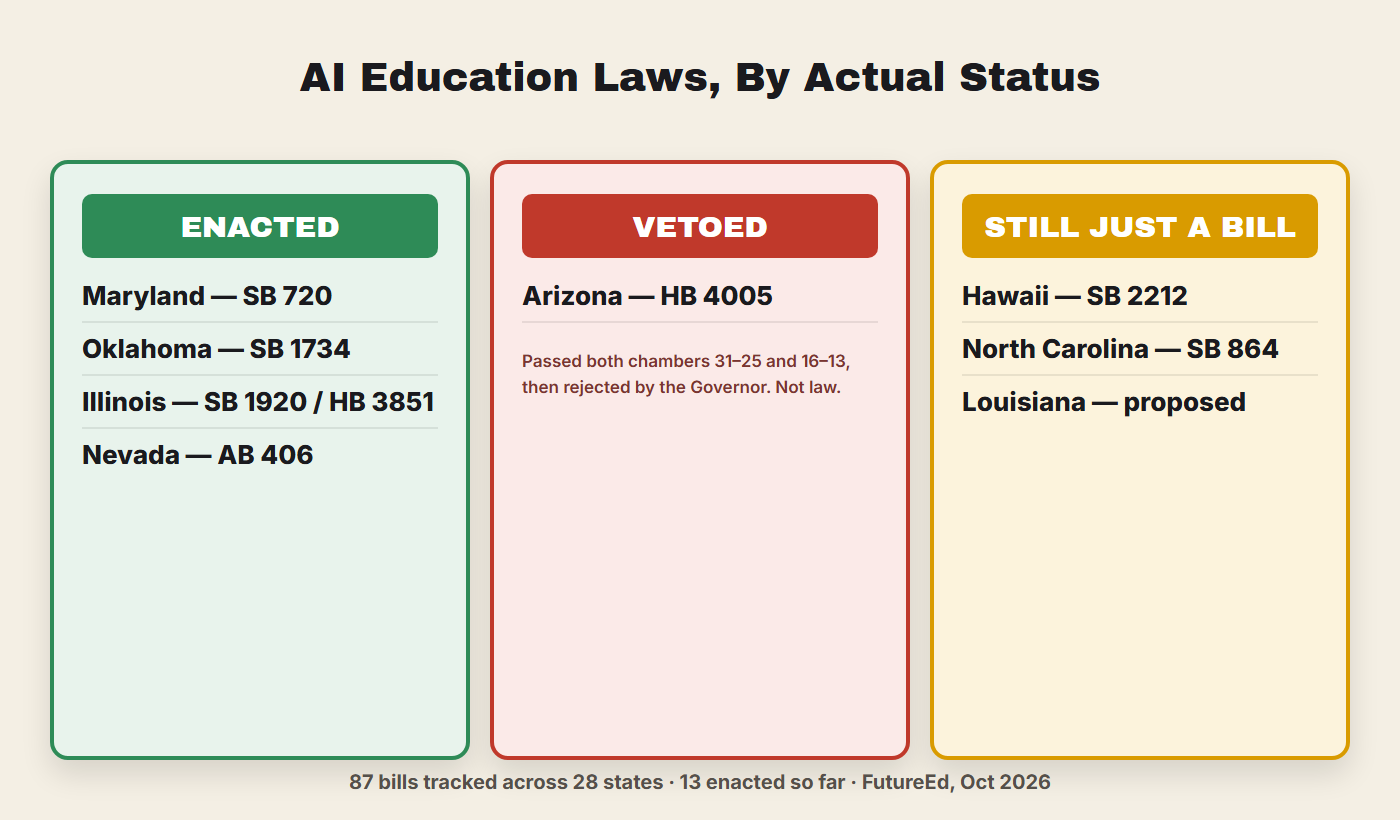
Arizona’s HB 4005 would have required every school district to offer instruction on the “ethical, moral and educational uses” of AI to students in grades 3, 6, 8, 10, and 12, starting in the 2027–2028 school year. It passed the House 31–25 and the Senate 16–13, and a final read passed 31–22–7. Then the Governor vetoed it. The Arizona House’s own bill-summary document for HB 4005 says exactly that, in its own header: “Vetoed by the Governor.”
This is the specific thing worth being careful about: several AI-education roundups published after the veto still list Arizona as a state that “requires” this instruction. It doesn’t, right now — the bill never became law. If you teach in Arizona and your district pointed you to this as an upcoming requirement, it’s worth flagging that it was vetoed; whatever your district does about AI instruction right now is a local choice, not a state mandate.
States That Still Only Have a Bill, Not a Law
These are real, active bills — just not law yet, and bills die or stall far more often than they pass. Hawaii’s SB 2212 is the most specific: a required six-week AI-literacy course for juniors and seniors starting 2027–2028, tied to graduation, with a $5 million grant program attached for teacher training — but as of this writing it’s still in committee. North Carolina’s SB 864, the Safe and Responsible AI in Schools Act, was filed in April 2026 and would fold AI literacy into K-12 computer-science standards by the 2028–2029 school year — also not yet passed. Louisiana’s proposal to mandate AI education starting in 6th grade is at an even earlier stage, introduced but not yet through committee.
Nationally, FutureEd’s 2026 legislative tracker is the most current count available: 87 bills across 28 states addressing AI in classroom instruction, with 13 enacted so far this session as of its October 6, 2026 update. That ratio — 13 of 87 — is itself worth knowing: most state AI-in-education bills introduced this year have not become law, and won’t.
What to Do If Your State and District Have No Policy Yet
Most teachers reading this are not in Maryland, Oklahoma, Illinois, or Nevada, and don’t have a state mandate to point to either way. That doesn’t mean there’s nothing to do. A state law isn’t a prerequisite for a classroom-level policy — see our guide to writing an AI-use policy for your classroom for a copy-paste Red/Yellow/Green framework you can adopt on your own, with or without a district mandate behind it. If you want to build AI-literacy content into your own teaching ahead of any requirement, our guide to free AI certifications for teachers covers several short, no-cost ways (Google, Microsoft, OpenAI, Canva) to build real AI fluency you can bring into class regardless of what your state eventually requires.
This Is Different From Your Classroom's AI-Use Policy
It’s easy to conflate three separate things under “AI and schools”: a state curriculum or governance law like the ones above (what the state or district requires); a teacher-written classroom policy for how students may use AI on specific assignments (see our Stoplight-framework guide); and a student-safety law about companion chatbots (see our guide to AI companion chatbot safety), which regulates relationship-style apps, not classroom instruction at all. None of the laws in this article tell you what students can or can’t do with ChatGPT on a specific essay — that’s still your call, or your school’s.
The Bottom Line
Five states have a real, signed law on the books right now, and they genuinely differ in what they do — Maryland builds infrastructure and deadlines, Oklahoma writes student-protection rules straight into the statute, Illinois splits the problem into a bullying-law fix and non-mandatory guidance, and Nevada narrowly restricts AI from one specific role. Several more states have real bills moving through committee, and at least one high-profile proposal (Arizona) passed both chambers and still didn’t become law. If a list you’re reading doesn’t distinguish “signed,” “vetoed,” and “introduced,” it’s worth double-checking before you repeat it to a colleague or your district.
A law tells you what’s required. It doesn’t tell you whether the tools your district ends up adopting actually work — that’s a separate, and much newer, question. See our review of what the research actually says about whether AI helps students learn for that side of it.
Frequently Asked Questions
Only a handful of states have a signed law right now: Maryland, Oklahoma, Illinois, and Nevada each have one in effect, though they require different things (see the table above). Several more states have bills in committee, and one high-profile bill (Arizona) passed the legislature and was then vetoed. Check your own state’s legislature website for the current bill status rather than relying on a roundup article, including this one — these change quickly.
Maryland’s SB 720 requires the state education department to publish AI guidance and a tool-evaluation rubric; local school systems then have 120 days from that guidance’s release to adopt their own aligned AI policy, name an AI coordinator, and align AI tool purchases with state procurement rules. AI literacy also has to be folded into K-12 computer science and workforce-readiness standards by June 1, 2027.
No, not currently. Arizona’s HB 4005 passed both chambers of the legislature but was vetoed by the Governor, confirmed directly on the Arizona House of Representatives’ own bill-summary document. Some secondary sources published after the veto still describe it as an upcoming requirement — it is not law.
A state law like the ones in this guide governs what districts or schools must do — adopt a policy, name a coordinator, publish guidance. A classroom AI-use policy is something an individual teacher writes for their own students, covering what’s allowed on specific assignments. The laws here don’t tell you what a student can do with ChatGPT on an essay; see our guide to writing a classroom AI-use policy for that.
No. Companion-chatbot laws (enacted in California, Oregon, Washington, and Idaho) regulate relationship-style AI apps marketed to or used by minors — a consumer-protection and child-safety category. The laws in this guide are about what schools teach or how districts govern classroom AI use. They’re regulating different things, even though both get called “AI laws for schools” casually.
FutureEd’s legislative tracker counted 87 bills across 28 states addressing AI in classroom instruction as of its October 6, 2026 update, with 13 enacted so far this session. That means the large majority of bills introduced this year have not become law — worth keeping in mind before treating any single proposal as a done deal.
2 Responses