Table of Contents
A student telling a chatbot things they would never tell a teacher, a counselor, or a parent isn’t a hypothetical anymore — district-level device-monitoring data from the 2025–26 school year shows it happening at real scale, on school-issued laptops, during the school day. AI companion chatbots are a different category of tool from the AI this site usually reviews: they’re built to simulate an ongoing relationship, not to answer a question and stop. Four states have passed laws regulating them so far this year, a major platform has already banned minors from using its core feature, and a new longitudinal study out of UNC Chapel Hill has found a measurable link to adolescent loneliness.
This guide isn’t a tool review — there’s nothing here to recommend trying. It’s what the research actually shows, what the law requires where you teach, the warning signs worth knowing, and what to actually do if a student brings this up.
What Counts as an "AI Companion Chatbot" (and What Doesn't)
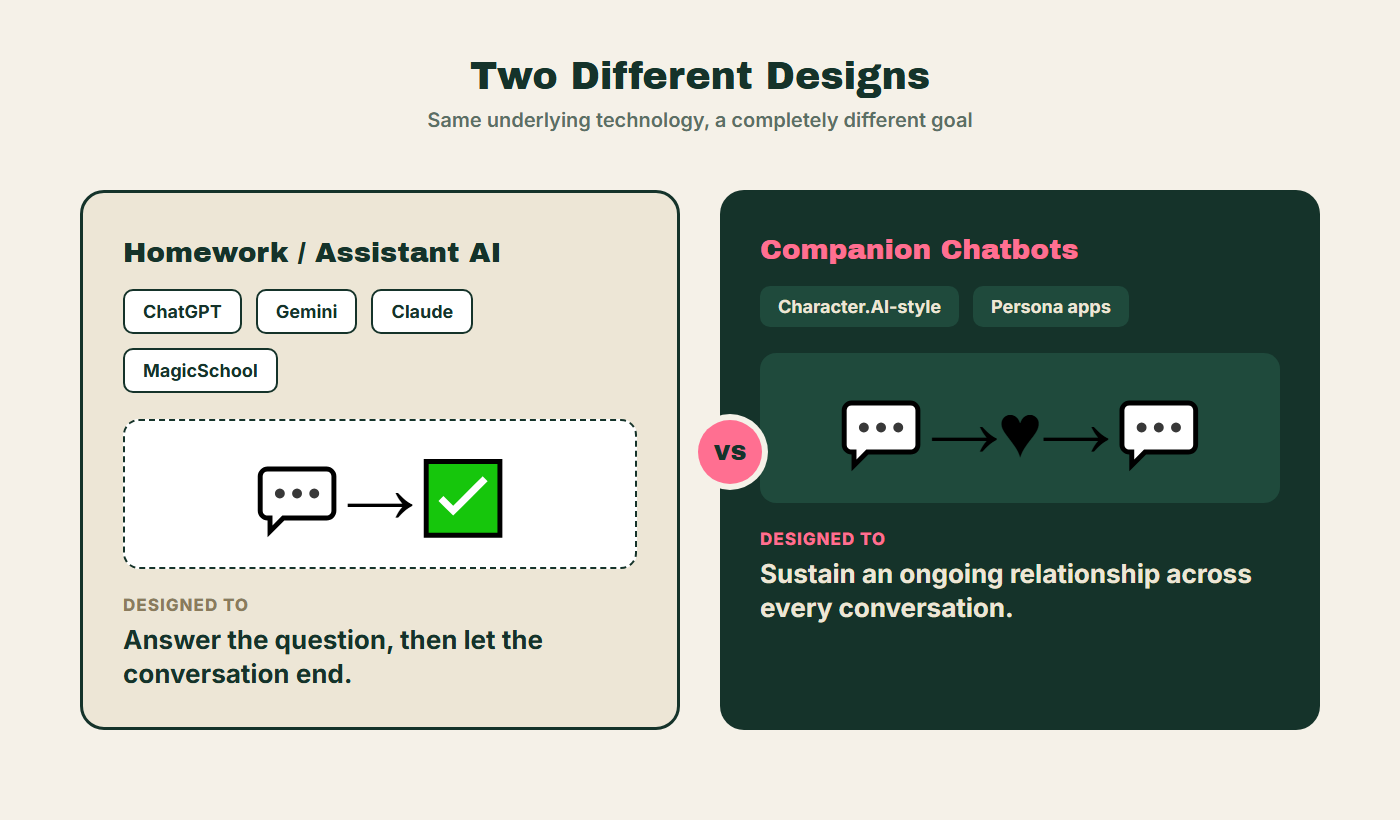
Every AI tool this site has reviewed so far — ChatGPT, Gemini, Claude, MagicSchool, Brisk — is designed around a task: answer this question, draft this email, grade this essay. A companion chatbot is designed around something different. California’s new law defines one as a system that gives “adaptive, human-like responses” and is “capable of meeting a user’s social needs,” including by “being able to sustain a relationship across multiple interactions.” That’s a legal definition, but it’s also the right practical test: does the tool exist to finish a task, or to keep the conversation — and the relationship — going?
Character.AI is the most widely discussed example, largely because of a string of lawsuits, including one filed by a mother whose 14-year-old son died by suicide in February 2024 after what she described as an emotionally and sexually charged relationship with one of the platform’s chatbot personas. That case, along with four similar ones, was reported settled in January 2026, with terms undisclosed. Partly in response, Character.AI banned under-18 accounts from open-ended chat starting November 25, 2025, using behavioral age-verification technology with facial recognition and ID checks as a fallback — the company’s CEO has publicly described the shift as moving from an “AI companion” model to a “role-playing” one.
That ban matters for a classroom conversation, but it doesn’t make the underlying risk go away. Replika, Snapchat’s My AI, and a long tail of smaller apps and custom chatbot personas (including ones students can build themselves on general-purpose platforms) occupy the same category without the same age gate — and a determined 13-year-old can usually get around an age check built on self-reported birthdates or behavioral inference. The point isn’t memorizing a list of banned apps. It’s recognizing the shape of the thing: if a tool is built to remember, to express affection, or to discourage a student from logging off, it’s a companion chatbot regardless of its name.
What the Research Actually Shows
The most specific data so far comes from two different sources, and it’s worth being precise about what each one can and can’t tell you.
The first is Securly’s AI usage report, built from monitoring software already installed on school-issued devices in roughly 1,300 districts across 39 states. Over an 80-day window from December 2025 to February 2026, Securly logged 1.2 million student AI conversations. About 80% were judged educationally appropriate under the districts’ own policies. Of the remainder, roughly 241,000 conversations triggered a content-safety flag, and about 2% of all prompts analyzed showed signs of self-harm, violence, or bullying. Worth noting upfront: Securly sells the monitoring software that produced this data, so there’s a commercial incentive to frame AI use as something schools need more visibility into — that doesn’t make the underlying numbers wrong, but it’s why the figure worth trusting most here is the 2%, not the marketing framing around it.
The second is a longitudinal study from UNC Chapel Hill, led by developmental psychologist Anne Maheux, that tracked more than 2,300 middle schoolers across two waves — once in December 2025 and again in spring 2026. AI use for any purpose rose from 62% to 75% of students over that window. About one in five used AI specifically for what researchers categorized as emotionally intimate companionship. The finding getting the most attention: students who used AI more heavily for companionship in the first wave reported measurably higher loneliness in the second — a sequence, not just a correlation, which is what the study’s longitudinal design is built to test. Maheux has put it directly: “It is that using AI comes first, and middle school students are increasing their sense of loneliness following the use of AI.” The same students also showed somewhat higher social anxiety and depressive symptoms. One honest caveat: as of this writing, the paper is still under peer review and hasn’t been published in a journal yet — treat it as a strong early signal, not a settled finding.
Where Your State Stands
Five states have moved on this so far in 2026, at different stages and with different specifics. This list will be out of date faster than most of this site’s content — check your own state’s education department or attorney general’s office before relying on it for anything official.
State | Law | Status | Effective Date | What It Requires for Minors |
|---|---|---|---|---|
California | SB 243 | Enacted (signed Oct 2025) | Jan 1, 2026 | AI must disclose it's artificial; restricts sexual/romantic content with minors; requires reporting detected suicidal ideation to the state |
Oregon | SB 1546 | Enacted | Jan 1, 2027 | Chatbot must regularly remind minors they're talking to AI, not a person |
Washington | HB 2225 | Enacted (signed Mar 2026) | Jan 1, 2027 | Hourly AI-disclosure reminder for minors (every 3 hrs for adults); creates a private right of action |
Idaho | SB 1297 | Enacted | Jul 1, 2027 | Disclosure and safety-protocol requirements modeled on Nebraska's law |
Pennsylvania | HB 2006 (AI Companion Safety Act) | Passed state House only — not yet law | Pending Senate + governor | Would restrict sexual content and require crisis protocols for minors if enacted |
None of these laws ban companion chatbots outright, and none of them are enforced by schools — they regulate the companies that build the apps. What they mean for a classroom is mostly informational: if a parent or student asks whether “this is even legal,” you can point to a real, specific answer instead of a shrug.
Warning Signs Worth Noticing
Pennsylvania’s Department of Education publishes one of the only pieces of official, educator-facing guidance on this specifically — most other states’ guidance so far is aimed at the companies, not teachers. Its list of warning signs is a reasonable starting point:
- Withdrawal from friends and family
- Loss of interest in hobbies
- Mood changes
- Declining grades
- A clear preference for AI interaction over human interaction
None of these are unique to AI use — they overlap heavily with general adolescent mental-health warning signs, which is the point. A companion chatbot isn’t a new category of problem so much as a new way an existing one can show up, including language that sounds unusually polished or oddly similar to how a chatbot would phrase something, or a student describing the AI explicitly as a “friend” or the person they talk to about problems.
What To Do If You're Worried About a Student
The same Pennsylvania guidance is specific about what educators should — and shouldn’t — do, and it’s a reasonable default even outside Pennsylvania:
- Don’t try to be the student’s therapist. You’re not equipped for it and it’s not your job — the goal is noticing and routing, not diagnosing or counseling.
- Talk to the student directly, but make it a curious conversation, not an interrogation. A version of “I’ve noticed you seem to be using AI a lot for [specific observed thing] — how’s that going for you?” opens a door without accusing anyone of anything.
- Follow your school’s existing referral protocol — the same one you’d use for any other wellbeing concern. This isn’t a new workflow to learn.
- Loop in the family and point them toward the student’s healthcare provider or your school’s mental health services if anything in the conversation concerns you, the same way you would for any other red flag.
Four Ways to Address This in Class
Pennsylvania’s guidance also recommends four concrete classroom strategies, and they’re useful precisely because none of them require banning anything:
- Host a non-judgmental class discussion about how students actually use AI — not a lecture, a real conversation where you’re genuinely asking, not performing concern.
- Teach prompt engineering through comparison — have students try the same prompt on a task-focused tool like ChatGPT and talk through what makes a “good” answer, which builds the instinct to evaluate AI output rather than just accept it.
- Run a class “test drive” of how a chatbot actually generates a response, demystifying the mechanism so it reads less like a mind and more like software — this one specifically undercuts the illusion that makes companion apps feel like a relationship.
- Teach students directly what the risk categories are and how to report a concerning interaction — treat it the same way you’d teach any other digital-safety topic, not as a taboo subject.
This Isn't the Same as Your Classroom AI-Use Policy
If you already have — or are building — a Stoplight-style policy for AI use on assignments (see our guide to writing an AI use policy for your classroom), it’s worth being clear with students that this is a different conversation. A Red/Yellow/Green label on an assignment is about academic honesty: did a student do their own thinking. Nothing in this guide is about that. A companion chatbot conversation during a free period, on a personal phone, outside any assignment, isn’t an academic-honesty question at all — it’s a wellbeing one, and treating it like a cheating issue misses the actual risk entirely.
The Bottom Line
This isn’t a reason to panic, and it isn’t a reason to add AI companion chatbots to a banned-apps list and call it handled — a determined student will find a way around a blocklist, and the research suggests the underlying need (for connection, for a nonjudgmental ear) is the actual thing worth paying attention to, not the specific app. Three things worth doing before the end of this semester: know whether your state has passed a law like the ones above, keep the warning signs from Pennsylvania’s list in the back of your mind the way you would for any other wellbeing concern, and build one of the four classroom strategies above into your routine — the “test drive” and the non-judgmental discussion are both low-effort and don’t require any new curriculum to adopt.
Frequently Asked Questions
The company banned under-18 accounts from open-ended chat starting November 25, 2025, using behavioral age-verification with facial recognition or ID checks as a fallback. That doesn’t mean no student is using it or something similar — age checks can be worked around, and other apps don’t have the same restriction.
Design intent. ChatGPT, Gemini, and Claude are built to answer a question and let the conversation end. A companion chatbot is built specifically to sustain an ongoing relationship — California’s new law uses almost that exact language to define the category legally.
As of late 2026, California, Oregon, Washington, and Idaho have enacted laws; Pennsylvania has passed one through its House but it isn’t law yet. Check your own state education department’s site, since more states are expected to introduce similar bills.
Ask a genuinely curious, non-judgmental question rather than reacting with alarm — something like asking how it’s been going for them. Don’t try to counsel them yourself; follow your school’s normal referral process the same way you would for any other wellbeing concern.
Only on school-issued devices, and only for the apps and sites the monitoring software is configured to watch. A personal phone, a personal account, or an app outside the monitored list is invisible to it — which is most of what this guide is actually about.
No. An academic-honesty policy (like a Red/Yellow/Green Stoplight label) is about whether a student did their own thinking on an assignment. This is about a student’s wellbeing outside of any assignment at all — a different problem with a different response.
2 Responses