Table of Contents
Walk into a classroom in the UAE this year and AI literacy is now a required subject, starting in the earliest grades. Walk into a classroom in New York City and generative AI is banned outright through eighth grade. Both decisions were made in 2026. Both claim to be following the evidence. That’s the real story behind almost every “AI in schools” headline right now: nobody is actually working from the same evidence, because there isn’t much evidence yet.
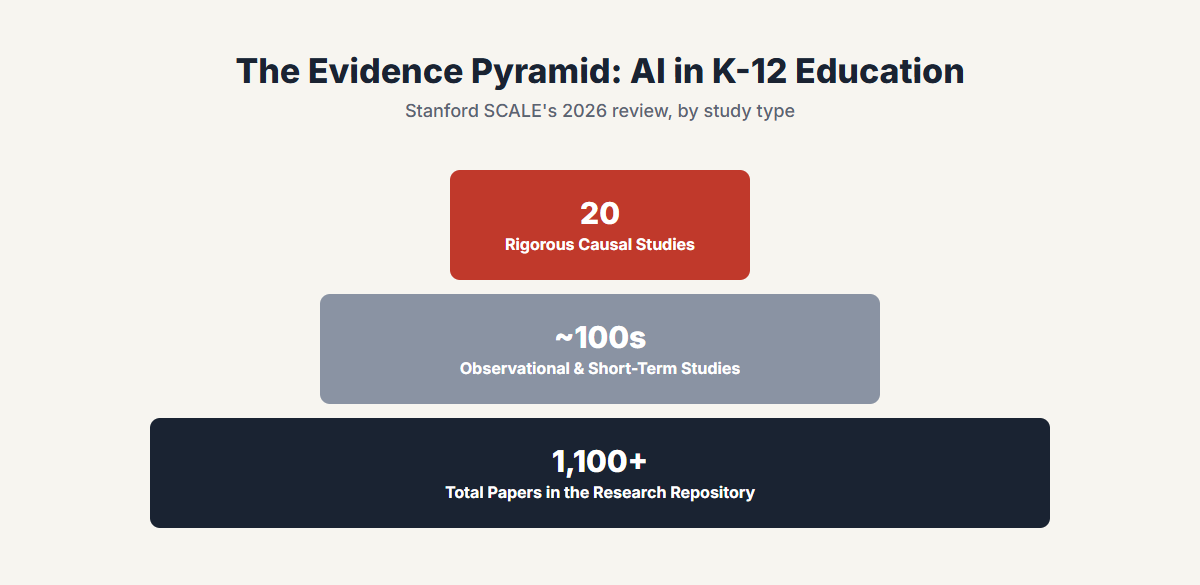
A major Stanford review published this year looked at more than 1,100 studies on AI in K-12 education and found that only 20 of them actually prove whether AI tools help students learn — the rest measure something else, like how the models perform or how often students use a tool. This article walks through what that research actually says, why Australia’s national education research body is telling schools to use AI “sparingly,” and what the gap between policy and evidence should change about how you evaluate a new AI tool in your own classroom.
The Headline Number: Only 20 Studies Actually Prove It
The Stanford Graduate School of Education’s SCALE initiative built a research repository that has grown past 1,100 papers on AI in K-12 education. When its researchers — Lily Fesler, JP Martinez Claeys, Chris Agnew, and Susanna Loeb — looked for studies that could actually tell you whether an AI tool changed outcomes for students or teachers, rather than just describing how the technology works or how it’s being used, they found only 20 rigorous causal studies in the entire set.
Their report, The Evidence Base on AI in K-12: A 2026 Review, states it plainly: “There are no high-quality causal studies of student AI use conducted in U.S. K-12 classrooms.” Not few. None. Most of what exists instead is technical development research, model-performance benchmarking, or observational studies that can’t rule out other explanations for what they’re seeing. The review also found the research skews heavily toward students as AI users, with far less attention paid to teachers and school leaders, and toward math, with literacy, other subjects, and social-emotional development much less studied.
That doesn’t mean AI tools don’t work. It means almost nobody has actually checked, in a way that would hold up, in a real U.S. classroom.
What the Evidence Actually Supports (So Far)
| Claim | What We Actually Know | Confidence | Source |
|---|---|---|---|
| Students using AI tools do better on tasks | Yes, while actively using the tool — math, writing, and programming tasks all showed gains | Reasonable, but narrow | Stanford SCALE, 2026 |
| Those gains hold up once the AI is taken away | Mixed — unassisted results sometimes improve, sometimes stay flat, sometimes get worse | Low / unresolved | Stanford SCALE, 2026 |
| Tools that scaffold reasoning beat tools that just generate answers | Yes — tools that guide, hint, or scaffold show more consistent gains than general-purpose answer generators | Moderate | Stanford SCALE, 2026 |
| AI saves teachers real prep time | Likely, based on teacher reports — a much thinner evidence base than the student-outcome findings above | Teacher-reported, not independently measured | Stanford SCALE, 2026 |
| Younger students benefit the same way older students do | No — researchers specifically caution against assuming this; evidence for early grades is the thinnest of all | Caution advised | AERO (Australia), 2026 |
Engagement Isn't Learning — Why That Distinction Matters
Most of what gets marketed to schools as proof that “AI works” is really a measure of engagement — how long students spend in a tool, how many sessions they complete, how teachers rate the experience. None of that answers whether students learned more.
Australia’s national education research body, the Australian Education Research Organisation (AERO), put a name on the risk in October 2026: “cognitive outsourcing.” AERO CEO Jenny Donovan warned that AI can become a crutch that disguises the fact that a student isn’t actually learning — citing a study where students who used AI to complete work couldn’t reproduce the same results on an exam without it. Donovan called it an “illusion of learning”: the work looks done, the tool was used correctly, and nothing durable happened underneath it.
Canada’s national teachers’ union raised a version of the same concern this month about the country’s new National AI Literacy Initiative, pointing to research linking AI reliance to declining reading scores and weaker teacher-student relationships — and noting that more than 80% of surveyed British Columbia teachers already worry about students becoming overdependent on AI. None of this means AI use is harmful by default. It means “students are using it” and “students are learning” are two different claims, and right now only one of them has much evidence behind it.
Why Young Kids Are the Biggest Question Mark
AERO’s October 2026 guidance is the most specific age-based recommendation to come out of any research body so far, and it’s worth taking seriously even outside Australia: avoid AI completely in the first three years of primary school, use it carefully after that alongside explicit instruction, and don’t introduce it in earnest until high school — specifically because that’s where it shows up in higher education and the workplace anyway.
The reasoning tracks with Stanford’s findings: the research is thinnest for young learners, most of it comes from short-term studies conducted outside the U.S., and almost none of it looks at primary-school-aged children specifically. AERO also recommends favoring tools purpose-built to guide reasoning over general-purpose chat tools that just hand over an answer — the same “scaffolding beats answer-generation” pattern from the table above.
What Teachers Are Already Reporting
Separate from the causal-outcomes question, there’s a smaller but real body of evidence on what AI changes for teachers themselves. Stanford’s review found that teacher-facing tools — lesson planning, rubric generation, differentiation — may genuinely reduce prep time and support instructional decisions. The honest caveat: this is teacher-reported and observational evidence, not the kind of controlled measurement the 20 rigorous studies represent. It’s a real, usable signal. It’s just a different, weaker category of evidence than “this improved student learning” — worth being explicit with yourself about whether the claim you’re relying on is “this saves time” or “this helps students learn” — they are not the same claim.
Governments Are Moving Faster Than the Research
None of this evidence gap has slowed down policy. In 2026, the UAE became the first country to make AI a required K-12 subject — not technical training, but AI literacy taught through discussion, stories, and role-play in the earliest grades (one exercise has a teacher play “the robot,” with students learning how machines respond to precise instructions), with older students getting access to school-approved tools and 22,000 teachers slated for AI training.
In the U.S., the federal Presidential AI Challenge — a K-12 contest created by an April 2025 executive order — drew more than 20,000 students across all 50 states, Washington D.C., Puerto Rico, and dozens of Department of War schools overseas in its first year. Canada’s government unveiled a National AI Literacy Initiative in September 2026 built with the Alberta Machine Intelligence Institute, including a course for educators — the same initiative the Canadian Teachers’ Federation has publicly pushed back on, arguing it asks teachers to adopt AI before anyone has confirmed the tools are actually safe or effective, and calling for independent impact reporting from the companies building them.
…While Other Districts Are Hitting the Brakes
Other places are reading the same uncertainty and landing on the opposite answer. New York City Public Schools — the largest school district in the U.S. — announced a one-year moratorium on student-facing generative AI from pre-K through eighth grade starting with the 2026-27 school year, affecting several hundred thousand students. The restriction on AI companion chatbots specifically extends through high school; high schoolers otherwise get twice-yearly AI literacy lessons and a capped pilot program. Teachers aren’t covered by the ban and can still use approved tools for planning, though not for grading. Mayor Zohran Mamdani framed the pause as the city “studying the impacts of this technology” before expanding access. Norway has put a similar near-ban in place for primary-school children.
Put the UAE’s mandate next to New York’s moratorium and you get the real picture: these aren’t disagreements about the evidence. They’re different bets about what to do while the evidence doesn’t exist yet.
What This Actually Means for Your Classroom
None of this means “don’t use AI.” It means the burden of proof for any specific claim about a specific tool is still on the people selling it, not on you for asking. A few things worth changing in how you evaluate and use AI tools, based directly on the research above:
Favor tools that show their work over tools that just answer. This is the one result that shows up consistently across the research: tools that scaffold, hint, or guide reasoning produce more consistent gains than tools that generate a finished answer. If a tool’s main feature is “paste in the question, get the answer,” treat that as a caution flag for anything you want students to actually learn from, not just finish.
Be more cautious the younger your students are. The evidence gap is worst for early grades specifically. A tool that’s fine for a high schooler isn’t automatically fine for a third grader, and “it’s popular with teachers” isn’t evidence either way for that age group.
Treat “engagement” and “time saved” as real but separate claims from “learning improved.” Both are worth something. Neither one proves the other. If a vendor’s pitch blurs the two together, that’s worth noticing.
Build in your own check for transfer. AERO’s “illusion of learning” risk is specifically about work that looks done with AI help but can’t be reproduced without it. An occasional no-AI check-in on a skill you’ve been AI-assisting is a low-effort way to see whether anything actually stuck.
Questions to Ask Before Your School Adopts a New AI Tool
Given how thin the independent evidence still is, the questions worth asking before adopting anything new are less about features and more about what’s actually been checked:
Does the vendor cite independent, peer-reviewed research, or only its own case studies and testimonials? Is there any published study on the specific age group you teach, or only on adults and older students? Does the tool explain its reasoning, or just output a final answer? What happens to student data, and who besides your school can see it? And — the simplest, most practical one — is there any way for you to tell, in your own classroom, whether it’s actually helping students learn, rather than just whether students and administrators like using it?
A tool that can’t answer most of these isn’t automatically bad. It just means you’re the pilot study, not a customer buying something pre-validated — which is a fine thing to be, as long as you know that’s the deal.
This Fits Alongside Your AI-Use Policy and State Law — Not In Place of Them
This article is about whether AI tools work — the research question. It’s a different question from what your school or state actually requires you to do, which is covered in our guides to writing an AI-use policy for your classroom and AI literacy laws by state. You can be fully compliant with your state’s law and your district’s policy while still making bad tool choices, if you only ever ask “is this allowed” and never “does this actually help.” Use all three together: the law tells you what’s required, your policy tells you what’s permitted, and the evidence above should tell you what’s actually worth doing inside those limits. For a broader look at what’s available, our full library of AI tool guides is a reasonable next stop.
The Bottom Line
The honest answer to “does AI help students learn” right now is: sometimes, for some tasks, while students are actively using it — and almost nobody has rigorously checked whether that holds up once the AI is taken away, especially in U.S. K-12 classrooms, especially for young learners. That’s not a reason to panic, and it’s not a reason to adopt every new tool uncritically either. It’s a reason to keep doing exactly what you’d do with any other unproven claim in your classroom: ask what’s actually been checked, favor tools that make students do the thinking instead of skipping it, and watch for the difference between work that looks finished and learning that actually stuck.
Frequently Asked Questions
Based on current research, sometimes — the clearest evidence is for tasks students complete while actively using the tool (math, writing, and programming all showed gains in Stanford’s 2026 review). What’s much less clear is whether that benefit holds up once the AI is taken away, because almost no rigorous U.S. K-12 study has checked.
Stanford’s SCALE initiative reviewed a repository of more than 1,100 papers on AI in K-12 education and found only 20 rigorous causal studies that measure real outcomes for students or teachers, rather than just technical performance or usage patterns.
The evidence specifically is thinnest for younger students. Australia’s national education research body (AERO) recommends avoiding AI entirely in the first three years of primary school and introducing it carefully afterward alongside explicit instruction.
Engagement measures whether students use a tool and how they feel about it. Learning measures whether they can do something they couldn’t do before, independent of the tool. A tool can have high engagement and little measurable learning benefit at the same time — which is exactly what the current evidence gap is about.
Not necessarily. The research gap is a reason for skepticism about specific claims, not a reason to avoid AI altogether. Favoring tools that scaffold reasoning over tools that just generate answers, and staying more cautious with younger students, reflects what the current evidence does support.
See our guide to AI literacy laws for schools, which tracks which states have signed laws, what they actually require, and which states still only have a bill in committee.
2 Responses